
Neither Bombs Nor Pragmatism Can Build Our Future
written by Dae-Han Song
During the G7, President Lee Jae-myung promised President Donald Trump construction of ten ships for the US Navy. True to Lee’s pragmatic approach to politics, the ship order wins points with Trump while increasing production for Korea. This also helps realize Lee’s vision to make South Korea the number four arms exporter in the world, which it achieved in 2025 by rearming European countries, and hopes to continue by meeting the unfulfilled demand from a fall in Chinese and Russian arms exports.
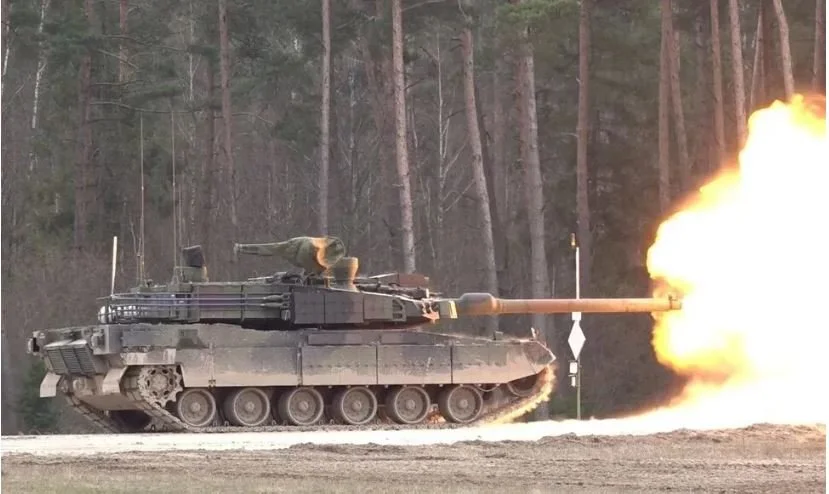
A K2 tank carries out a firing test in Poland. (courtesy Hyundai Rotem)
In a world where defense budgets are ballooning (driven by war and Trump’s warmongering that US allies increase their military spending), the Lee Administration sees weapons production—along with semiconductors and aerospace—as a strategic industry that can grow South Korea’s economy, a type of Military Keynesianism. Yet, while effective in achieving short-term gains, when confronted with global warming, arms production (especially for profit and to arm US imperialism) pours gasoline on a planet already burning from war and global warming. As such, in the long-term, it denies us the world that we must build for all of us to survive and thrive.
Short-Lived
Undeniably, Lee’s pragmatism has yielded results, starting with winning over Trump’s support: much to the chagrin and consternation of pro-Trump/pro-Yoon forces in South Korea, Trump offered Lee enthusiastic support in the latter’s visit to the US. Furthermore, during Trump’s tariff war against the world, Lee’s negotiating team won some relief from tariffs (despite the US’s free trade agreement commitments) by offering $150 billion to Make American Shipbuilding Great Again (MASGA): effectively, a promise to help the US deal with its backlog of maintenance and construction of ships for its Navy, including for Trump’s golden fleet. Furthermore, Lee’s cooperation with Trump around expanding semiconductor foundries in the US laid the foundation for the current AI boom in South Korea that fueled the KOSPI index to break through record highs.
Yet, if his pragmatism has effectively navigated the present, it is unable to chart a path out of it.
Not only is there a risk that once US semiconductor producers expand their capacity they will crowd out Korean companies and effectively burst Korea’s AI bubble (the KOSPI is recovering after just plummeting by 10%), but untrammeled reckless production of chips for energy and water guzzling data centers exacerbates our looming global warming threat. Most critically, building closer relations with Trump by further arming him and staking South Korea’s fortunes on exporting weapons mires South Korea deeper into war and destruction. Arming the United States with ships, critical minerals refining, and semiconductor chips enables the United States’ unilateral military and economic aggressions against the world as it wages its New Cold War.
Invest in Sustainability, Not Destruction
Ultimately, military spending diverts funds from the green transition and accompanying jobs we so desperately need. More specifically, the world spends almost $3 trillion on war, while the global funds for a just transition are short by $2 trillion.
Furthermore, its reliance on heavy industrial production (e.g., steel, critical minerals), daily operations (e.g., fuel for ships, planes, bases), military exercises (flying a B-52 for an hour equals driving for 7 years), and the actual destruction from war (e.g., Iran, Gaza) results in further environmental degradation and global warming. If the militaries of the world were one country, they would constitute the fourth largest greenhouse gas emitter. The US military alone emits more than 140 individual countries.
Building the Future Today
The Tricontinental Institute for Social Research defines the future as not an extension of the present into next year or the next decades but as a break with it. For the rest of us to achieve the future, it must be wrested from the hands of those that seek to perpetuate the present order even if it means global destruction. While the path towards the future is not clear, we must, nonetheless, prepare for it by building up our movements. This organizing can and must take many forms to fit the time, place, and conditions that we are embedded in.
This means that we must build up international solidarity against Trump’s unilateral aggressions around the world. That is what drives the International Strategy Center’s work organizing solidarity for Cuba, organizing events around Cuba’s medical solidarity and transition to renewable energy.
In other instances, it can involve running an electoral campaign as a way to build long-term community organizing as happened in the campaign to elect Justice Party’s Hwang Kyung-san for the district council. Elections offered a brief moment when politics is in the air. So, organizers took to the streets, approached and engaged strangers in sidewalks, bus stops, parks, and followed-up with phone calls around issues that directly improved their lives: district services for single-person households, a center for victims of digital sexual violence (in this age of AI); a subway system; a nighthospital for children; increased neighborhood busses. Organizers started with issues in one’s communities and then expanded and connected to the rest of society and the world. It’s a concrete, albeit small, step towards the future and one of the countless many that are needed across Korea and the world to realize those qualitative shifts that can accumulate towards a rupture with our present.
Those that exploit and cannibalize the present like to say that politics is the art of the possible. To them, we invoke the words of the late Marta Harnecker and declare our struggle to make the impossible today, possible tomorrow. The future depends on it.