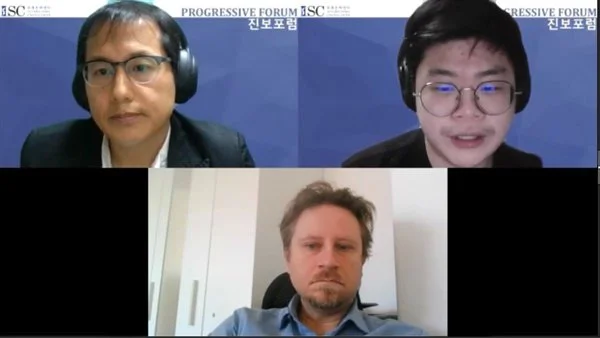
Kim Jong Min has been involved in South Korean progressive political parties for the past 20 years beginning with the Democratic Labor Party that had been established in 2002, followed by the last 10 years in the Justice Party. He is currently the co-President of the civil society organization Together Seoul and, in this past presidential election, he was in charge of the Strategy Headquarters for the Justice Party.
Read MoreToday the ISC had the tour at Seodaemun Prison History Hall where we can learn about Japanese colonial era. We met up with 7 participants of various backgrounds outside of the museum, held a tour and discussion through the museum, and continued conversation over dinner at a nearby traditional market. We discussed parallels between other examples of colonialism, holes and biases in our historical educations, and what led to the Japanese Colonial Era, the following US imperialism, and Issues that remain unresolved. As this is the first in a series, keep your eyes out for the next ISC tour, and our follow up movie night!
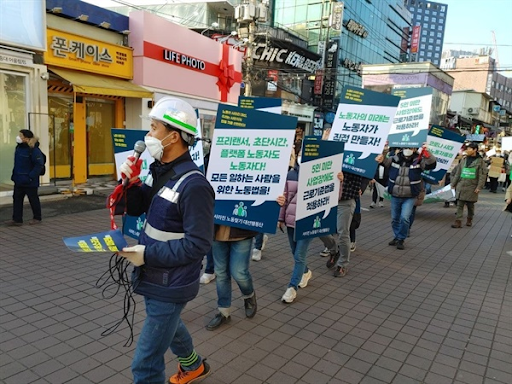
Read More. The political establishment and its presidential candidates pay no attention to the workers losing lives from industrial accidents, the women suffering from gender-based violence, the LGBT community subject to harsh discrimination, and the disabled with limited access to basic rights. This is why the Joint Electoral Action movement started, to take the people’s demands to the streets, rather than relying on politicians to speak for them.
Read More미국민주적사회주의자는 코리아 피스 나우, 국제전략센터, 위민크로스DMZ, 노둣돌과 같은 단체들과 연대하여 미국의 지정학적 이익을 위한 군사적, 경제적 간섭 없이 한반도가 평화, 자주, 화해를 만드는 과정을 시작할 수 있게 미국이 북한 여행금지 조치와 제재를 철회하고 한국전쟁의 공식적인 종전을 추진할 것을 촉구하는 바이다.
Read MoreDeinstitutionalization is not simply a matter of physical space that calls for the dismantling of large-scale care institutions. The institutionalized disabled must return to their families, and to society at large. The reality is that many deinstitutionalized disabled rely on the support of their families. However, care from their families is not enough, and society and the state must take responsibility. If the government simply postpones this process as it readies itself, then the process will never begin. The government must recognize deinstitutionalization as a responsibility and then actively begin its implementation.
There can be no dignity for anyone, without dignity for the disabled.
Read MoreTo help explain the crisis in Ukraine, the International Strategy Center (ISC) interviewed Volodomyr Ishchenko (Ishchenko), a Research Associate at Osteuropa-Institut Berlin and a member of PONARS Eurasia. Ischenko’s work on deficient revolutions and Ukrainian protest movements have made him a sought out left wing voice on Ukrainian politics, including interviews and articles with the Jacobin Magazine, Al Jazeera, and Truthout. Below is an excerpt of an interview with Ischenko by the International Strategic Center for our monthly Progressive Forum.
Read MoreLet us examine social housing in Korea. The Korean Social Housing Association was founded in 2015, and has supplied 4,389 (3,316 in Seoul, 883 in Gyeonggi-province) housing units in the Seoul metropolitan area as well as the Jeollabuk-do province, and the city of Busan. With cooperatives, schools, small and medium enterprises and non-profit organizations participating, the Association provides social housing appropriate to Korea’s conditions (revitalizing empty homes, collective housing etc.). However, still in its nascent stage, it is financially dependent on local government funding, thus leading to a very low supply. The current data casts doubt over the future sustainability of the Association, and a new direction of improvement must be sought.
How Dutch social housing reached such a high distribution
The Netherlands’social housing started in the 19th century to solve the housing crisis of urban workers. Through the World Wars, the urban housing shortage worsened, and the government supported the establishment of cooperatives to provide workers with social housing. However, unlike Korean public housing, which is limited to low-income households, Dutch social housing was universal, available to everyone. In addition, the Netherlands’ social housing is operated not by the government but by housing associations (80% non-profit, 20% for-profit). Currently, the Netherlands has 2.25 million units of social housing. And in its capital, Amsterdam, nine housing associations under the Amsterdam Federation of Housing Associations own and operate 190,000 housing units.
Read MoreLike the rest of the world, South Korea is also experiencing economic difficulties due to COVID-19. In Korea, resentment among self-employed shopkeepers is increasing. This is because the government's measures for self-employed shopkeepers are not enough while the latter have to bear great financial losses due to the government's social distancing measures. The government’s compensation for the shopkeepers remains paltry and its social distancing measures are sacrificing them again.
Read MoreWe invite Fatima Hassan, co-founder and director of Health Justice Initiative and discuss how to dismantle justice inequity and injustice and finally resolve the COVID19 pandemic.
Read MoreThe ISC, the Yongsan Citizens' Alliance, Justice Party of Seoul, the South Korean Network for Housing Rights and Solidarity for Housing Rights talk with Volkan Sayman (sociologist and researcher with the Expropriate Deutsche Wohnen & Co.) about the organizing that achieved the victory, the challenges and tasks ahead, and their vision of social housing.
Read MoreNov. 25 is the International Day for the Elimination of Violence against Women. The date was first selected in 1981 to honor three sisters who had fought against the Dominican dictatorship. In 2000, it was designated an international day by the UN.
Read MoreAs the world braces to deal with global warming, there is much focus on Green New Deals that can stimulate the economy, provide good paying jobs, and transition our economies away from fossil-fuel intensive production and towards sustainable production. Economist, activist, and co-founder of the Jubilee 2000 campaign (to forgive Third World Debt) Ann Pettifor describes how a Green New Deal might be funded by government financing and how it must radically transform our economies to be sustainable and equitable. This information deck summarizes her key ideas as well as critically evaluating them.
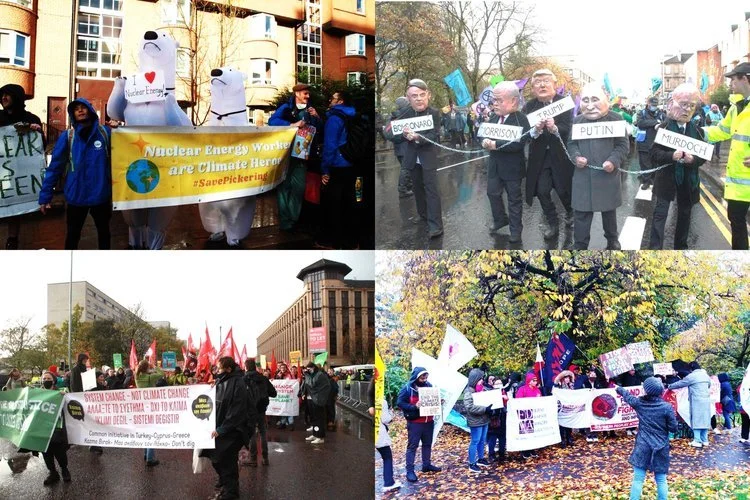
The 26th UN Climate Change Conference (COP26) held in Glasgow, Scotland, ended on November 13. The meeting, which began on October 31 and lasted for about two weeks, was a meeting where countries gathered and discussed how to "keep" the Earth's temperature rise below 1.5 degrees Celsius. Ahead of the COP26, or during the course of the COP26, agendas on how much carbon emissions should be reduced and how to reduce them were at least mentioned and made the most important headlines.
However, it has only been a week since COP26 ended, and news about the climate crisis is hard to find. However, even at this time, the climate crisis is ongoing everywhere. Then, why does the agenda of the climate crisis disappear without being "keeped"?
Read MoreIt is a cloudy afternoon on November 13.
A young man steps out into the streets of Seoul, holding a copy of the south Korean labor laws. Gasoline fire consumes his body with every step. With labor movements suffocated by the regime, this is his last declaration against inhuman exploitation.
“We are not machines,” he cries through the flames. “Do not let my death be in vain!”
His name is Chun Tae-il.
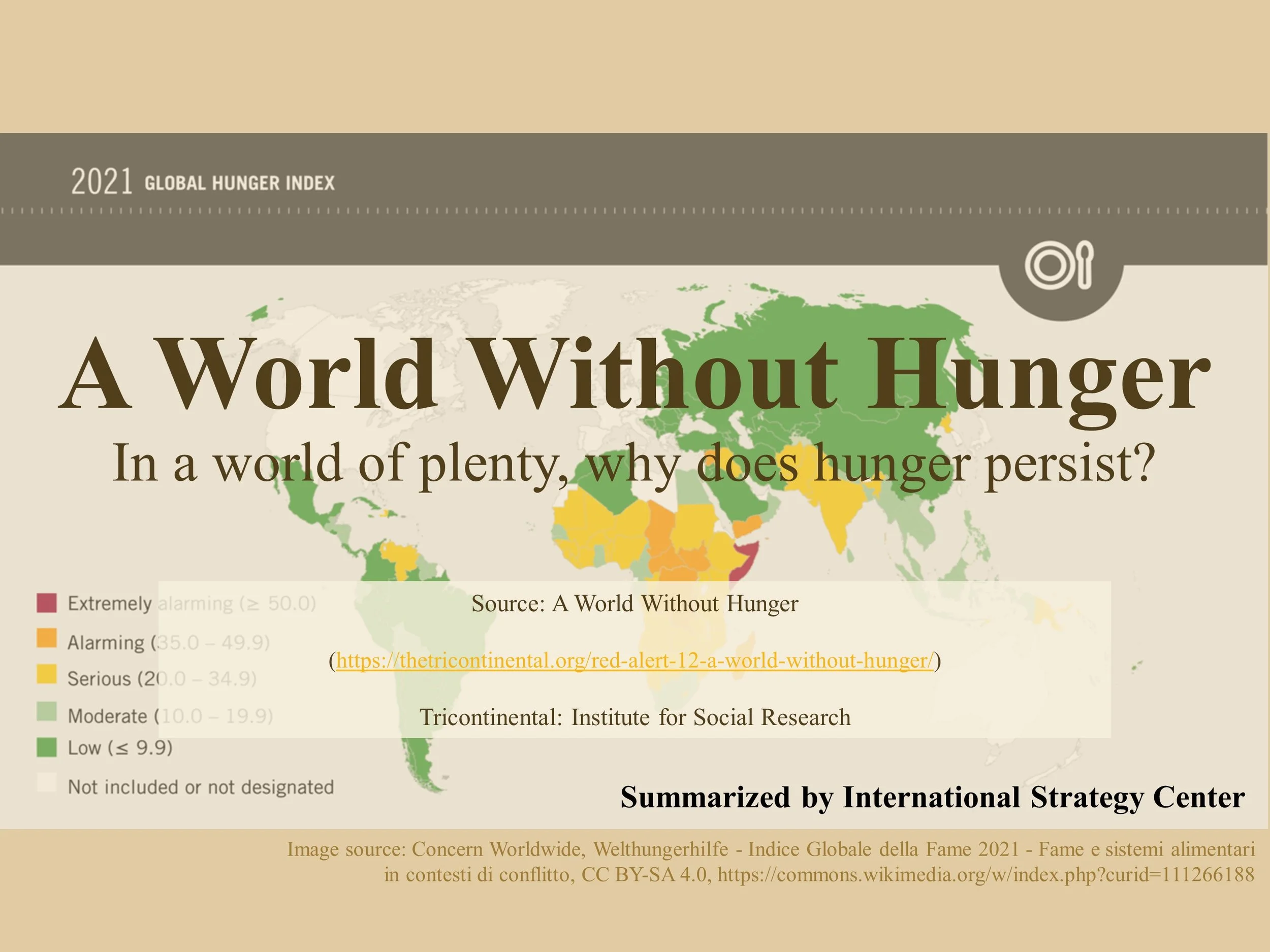
Read MoreIt is not overpopulation that causes hunger as is often argued, but rather inequality and a profit-driven, agribusiness-dominated food system in which the basic material need for food for hundreds of millions of people – at minimum – is sacrificed to quench the hunger for profit of the few.
Read MoreOn October 7th, at 7pm, the International Strategy Center welcomed Vijay Prashad to the Progressive Forum monthly series. Vijay Prashad -- author, journalist, international solidarity activist, and director of the Tricontinental Institute for Social Research -- educated and engaged with us about Afghanistan's past, present, and future.
Read MoreA few countries have done relatively well in responding to COVID-19, and they all approach health care and public health very differently from the United States, even if their economies are capitalist. I focus now on one of those countries that I know best: South Korea. I then move the focus to that other mysterious, noncapitalist country on the same peninsula: North Korea.
Read MoreOn August 22nd, the International Strategy Center held the online event, #LetCubaLive, with Ricardo Huaimachi in attendance. Interested in a more comprehensive understanding of Cuba that goes beyond the distorted mainstream media coverage, we discussed the historical context of the July 11th anti-government demonstration, Cuba's COVID19 response, and the status of Cuban socialism and democracy. The ISC plans on continuing exchanges like this in the future, as well as furthering our solidarity work with Cuba.
Read MoreToday, all over the world, housing is devouring our homes. More specifically, the real estate market is converting homes into housing to be sold and speculated at a profit, pricing out tenants, driving out residents, and stripping people of access to dignified and adequate shelter.
Read MoreThe lesson here is twofold. The first is that our struggle, wherever we are, is one. All across the world, we fight the same battle against the forces of power and violence that seek to rob us of our freedom and dignity as human beings. The bullets that murdered the Gwangju citizens, and the bullets that today murder Palestinians, are exactly the same down to the millimeter. Racial and sexual discriminations, imperialism, capitalism, are many heads of the same beast. The second is that our memories give us strength. To forget is to give up, and to give up is to fail. Without remembering our yesterday, we cannot organize today, and we cannot win tomorrow.
Read More