How far has the militarization of space progressed?
As of April 2023, 18,997 pieces of space debris orbit the Earth. This debris includes spent rocket stages, defunct satellites, and other fragments from various space activities. The increasing number of satellite launches raises the likelihood of collisions between debris and active satellites. Such collisions would generate even more debris, which could significantly increase the risk of further collisions and potentially disrupt the satellites we rely on for communication, navigation, weather forecasting, and other essential services.
Read More
Red Star Over Korea
During the colonial era, communists were the most targeted and repressed group in the peninsula, but everything changed after Japan’s defeat in the Second World War. The soon-after freed communists would hold positions in at least half of the people's committees that were prepared to govern a post-colonial Korea. While the Comintern advised communists to build support among the masses, right-wing nationalists continued to lose relevance in exile and the local elite discredited themselves through colonial collaboration.
Unfortunately, the US military occupation and the Korean War would eradicate the Korean Left (the first casualty of the Cold War). Nevertheless, Communism represented the radical hope for an equally nationalist and cosmopolitan Korea, a dream kept alive by the Soviet Union's strong commitment to the colonized world. The Comintern’s guidance may have been heavy handed but they provided the resources and connections Korean communists needed to survive persecution and showed us what we can achieve when the left combines international solidarity with local organizing.
Read More
Fighting the 24-Hour Workday
We thank Jun and Yolanda for sharing home care workers struggle to end sweatshop labor in New York City. Homecare workers are arguing that the attack on their rights will spread to other industries, but it’s also true that it’s spread to other countries, as we are seeing with the South Korean government’s attack on migrant care workers rights. Home care workers have shown that we must move beyond trade union consciousness to a genuine mass movement that organizes workers where they live and where they work, grounded with an analysis of US imperialism and global capitalism.
Read More
76 years and 7 months
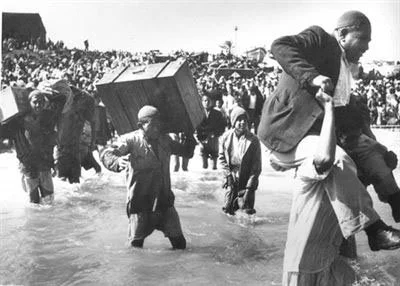
Every year on May 15, we commemorate the atrocities of the Nakba, Arabic for catastrophe, during which more than 750,000 indigenous Palestinians were forcibly expelled from their homelands as a result of the Zionist pursuit of a Jewish ethno-state atop their homes in 1948. As Israel declared its independence on May 14, 1948, Zionist militias had been laying the groundwork for this ethnic cleansing by carrying out campaigns of terror against villages and cities across historic Palestine, leaving devastation and massacres in their wake, from Deir Yassin to Tantura. Those who fled this violence would become one of the largest refugee populations in the world, a population that continues to endure displacement today. As we mark these events amidst the backdrop of a seven-month-long genocide against Palestinians in Gaza, it’s more clear than ever that the Nakba never ended; its violence has persisted over the decades in the form of continued Israeli aggression and occupation, ethnic cleansing campaigns, house demolitions, the imprisonment of children, women, and men, and the persistent efforts to deny Palestinians any semblance of dignity, justice or self-determination.
Read More
Hyper-Imperialism
On the hundredth anniversary of Lenin’s death, the Tricontinental Institute of Social Research released a 21st-century update to Lenin’s monumental pamphlet, Imperialism: The Highest Stage of Capitalism. In its latest dossier, “Hyper-Imperialism,” Tricontinental explores how the United States, desperate to reverse its decline, is aggressively dragging the whole world into war, both conventional and economic. On March 9th, No Cold War hosted a panel of intellectuals, activists, and journalists from around the world to discuss how hyperimperialism has affected the Global South, from blockades in Latin America, to a militarized island chain in the Indo-Pacific, and bankrolling genocide in the Gaza Strip.
Read More
Chained Disability Activists Strangled by Police ‘Like that day 23 years ago’
58th 'Commute by Subway' protest underway at Seoul Station Sound equipment confiscated, press conference dismissed before even beginningDirector Park Kyung-seok chains himself to an activist "to avoid being dragged away "Police and Seoul Metro employees strangle Park while attempting to cut chains
Read More
Communes Against Capitalism
In a future where the world seems more hopeless than today, unemployment, fascism, and forever wars have metastasized beyond what states can manage. In a desperate bid to stay in power, the United States invades Iran, triggering a global famine. However, in M.E. O’Brien’s novel, “Everything for Everyone,” desperate and hungry New Yorkers launch an insurrection at Hunts Point Market, the world’s largest food distribution center. The rebels turn Hunts Point into the New York Commune, which sparks a worldwide revolution that finally takes down capitalism.
Read More
Korean movements demand: South Korea, stop arming Israel!
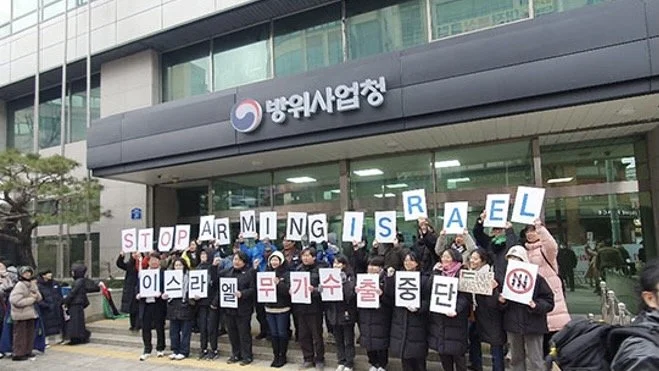
On January 19, 150 people protested in front of the Defense Acquisition Program Administration (DAPA) office in the city of Daejeon, demanding the South Korean government stop arming Israel. While Palestine may seem like a distant conflict to South Koreans, the South Korean military-industrial complex is a key pillar in the Israeli war machine. According to Peace Momo, Hanwha, South Korea’s leading defense company, signed a major technology cooperation and export deal with Israeli weapons company, Elbit Systems, at the Seoul International Aerospace & Defense Exhibition (ADEX) in 2021.
Read More
Gaza's Doctors Speak: We Need an Avalanche of Solidarity
Ultimately, the ceasefire is necessary, but that is just the beginning. As Dr. Gilbert states, "The root causes of all that we see is the occupation of Palestine…the colonial apartheid policies of Israel need to be addressed." Stopping at simply demanding a ceasefire would make us “complicit in only mopping the blood up from the floor and patching the wounds.”
Read More
The Cruel Face of Capitalism Hidden Behind Coconut Milk
In other coconut growing areas outside of Thailand, coconuts are harvested using people or machines. Moreover, a group of Indian researchers developed coconut picking robots in 2020 though they still have a long way to go for the commercialization of the technology. Since the use of animal labor in agriculture has been around for a long time, we may be able to understand the use of monkeys as a traditional Thai farming method. However, looking at the scale and intensity of the labor, it is clear that this is exploitation rather than traditional farming methods. Why should it be seen as exploitation? Behind this, in addition to the animal rights issue, there is the systemic problem called capitalism.
Read More
The Fashion Industry and Environmental Pollution
So, what should we do for the survival of all humanity and the preservation of our ecosystems? There seem to be only two possible approaches. Either we gather our collective strength, engage in a struggle to wrest political power from the privileged, and invest capital to save the environment ourselves, or, even if we can't take away their power, we must at least compel the privileged to invest capital in saving the environment. In whatever form, we must stop the unbridled pursuit of capital for the sake of the survival of all humanity. Otherwise, we cannot guarantee the right to survival for all.
What's even more frightening is the possibility that even if the Earth's environment is severely destroyed in the future, to the point where humanity is almost wiped out, some of the giant capitalists may continue to exist, utilizing the artificial intelligence and other technologies they monopolize. In other words, the colossal wealth may choose to ignore the existential crisis we feel.
Read More
Equality For All: South Korea’s Sexual Minority Movement
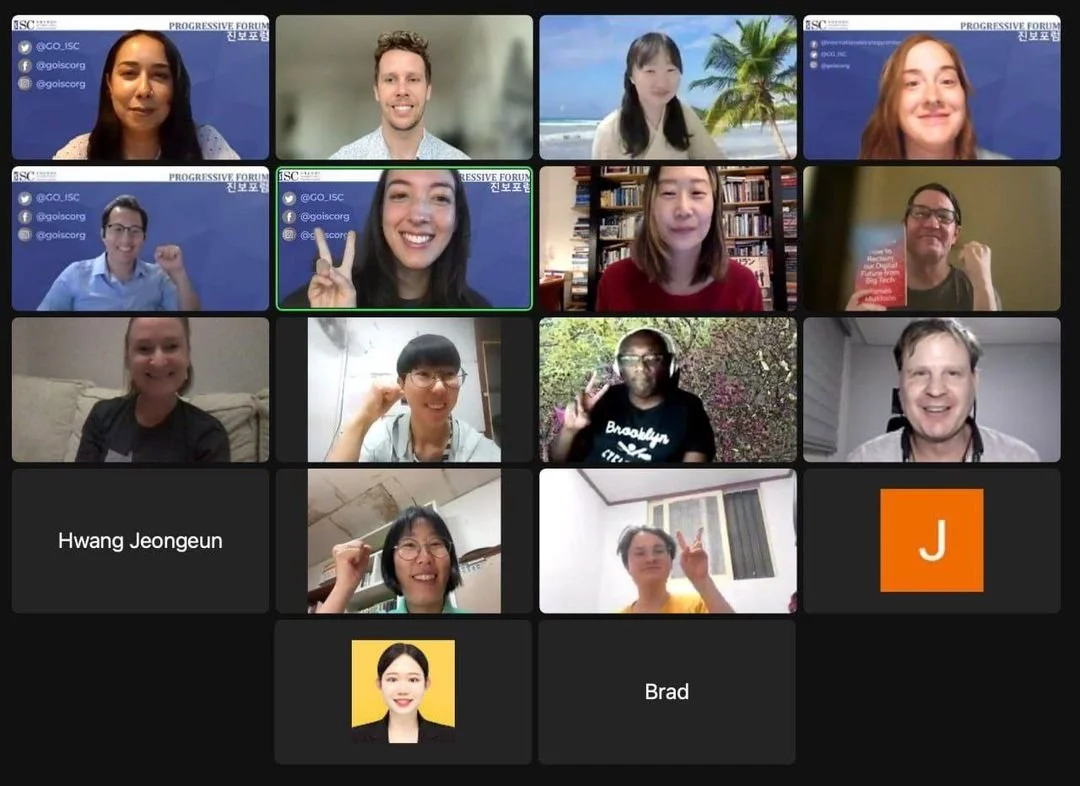
The International Strategy Center (ISC) spent June and July hosting events and study groups on queer issues. We have had movie nights and book clubs centered around media representation, queer theory in the context of leftism, and the HIV/AIDS epidemic in the US. On July 28th, we concluded these two months with our Progressive Forum interviewing Holic, the president of the Korean Sexual Minority Culture and Rights Center.
Read More
On Palestine
This summer, after two decades, I finally made the trip back to Palestine to visit my extended family, to connect with the land, and renew my understanding of what life is like on the ground for the millions of Palestinians who continue to live under Israel’s unjust and illegal occupation.
Read More
A New Peace Movement in Northeast Asia: South Korea’s Peacemomo
July 27th marked the 70th year anniversary of the 1953 ceasefire to the Korean War. In the three years leading up to the anniversary, South Korean peace movements organized the international campaign Korean Peace Appeal to end the Korean War with a peace treaty. Yet, the anniversary has come and gone and peace is nowhere on the horizon. In fact, rather than working towards defusing tensions in the Korean Peninsula, the Biden Administration is using North Korea as a cover for building a NATO-level trilateral alliance with South Korea and Japan against China.
Upon taking office, when South Korean President Yoon Seok-yeol sidestepped claims for historical accountability of Japanese colonialism, he cleared the way for the US’s regional “cornerstone” (Japan) and “linchpin” (South Korea) to connect with each other. In the process, they overcame the US’s roughshod San Francisco system, which had sacrificed justice against Japanese colonialism at the altar of anti-communism. On Aug. 18, to immunize the trilateral alliance from changes in administration, at Camp David, Biden, Yoon, and Kishida announced the “Spirit of Camp David” which would institutionalize annual trilateral summits, meetings, and consultations.
On Aug. 28th, to explore the state of South Korea’s peace movement and the tasks ahead for it, I met with Francis Dae-hoon Lee, a long-time peace activist and veteran of Korea’s democratization movement and a Professor of Peace Studies at Sungkonghoe University and Director of Peacemomo, a research institute for peace and education. The interview has been edited for clarity and brevity.
Read More
Platform Socialism: Democratizing the Internet
The interview was part of the International Strategy Center’s Progressive Forum where we interviewed James Mudoon, a senior lecturer in political science at the University of Exeter, a research association at the Oxford Internet Institute, and head of digital research at the Autonomy think tank. The interview was conducted by Mariam Ibrahim and edited for clarity and brevity by Matthew Phillips.
Read More
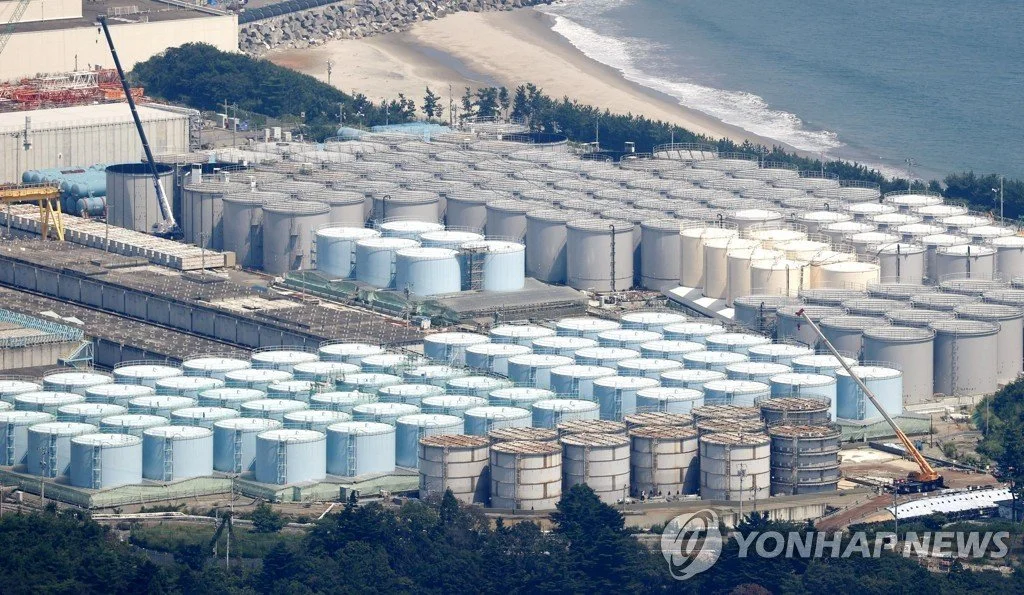
Fukushima Nuclear Wastewater Discharge : Why Must We Stop It?
With the backing of the United States and the IAEA, it is only a matter of time before the wastewater dump begins. Once the discharge starts, the Pacific ocean will be contaminated with radiation for the next three decades. With no clear prediction on how the radioactive discharge might disrupt the ecosystem of the ocean and the planet, what choices should we make? It is time for the people around the world to come in solidarity with the people of Fukushima and international environmental organizations to engage in a sweeping campaign to fight against the wastewater dump. Such a global ecological catastrophe must be stopped.
Read More
Japanese Fight Remilitarization
eishi Hinada is a National Executive Committee member of ZENKO (National Assembly for Peace and Democracy). ZENKO emerged in 1970 out of the student movement in the 1960s. He joined in 1981 as a university student activist in the anti-nuclear peace movement in Hiroshima.
Read More
Who Drove the Martyr Yang Hoi-dong to His Death?
On May 1, May Day, a construction worker set himself on fire. The crackdown of the construction union by the Yoon Suk-yeol administration drove Yang Hoi-dong to his death. His death is the social murder of the Yoon Suk-yeol government.
Illegal multi-level subcontracting is rampant, and delayed/unpaid wages ongoing. Construction workers who have struggled to change construction sites, which relegate worker safety to the background, demanding to be treated with respect as workers and technicians, are being cornered as/ turned into criminals accompanied by extortion threats at regular intervals. Since January of this year, there have been 13 seizures and searches, 15 arrests, and 950 union members subpoenaed for investigation. The massive crackdown against the construction union has taken the life of the martyr.
Read More